
How Long Does a Robot Mower Battery Last? We Ran the Numbers
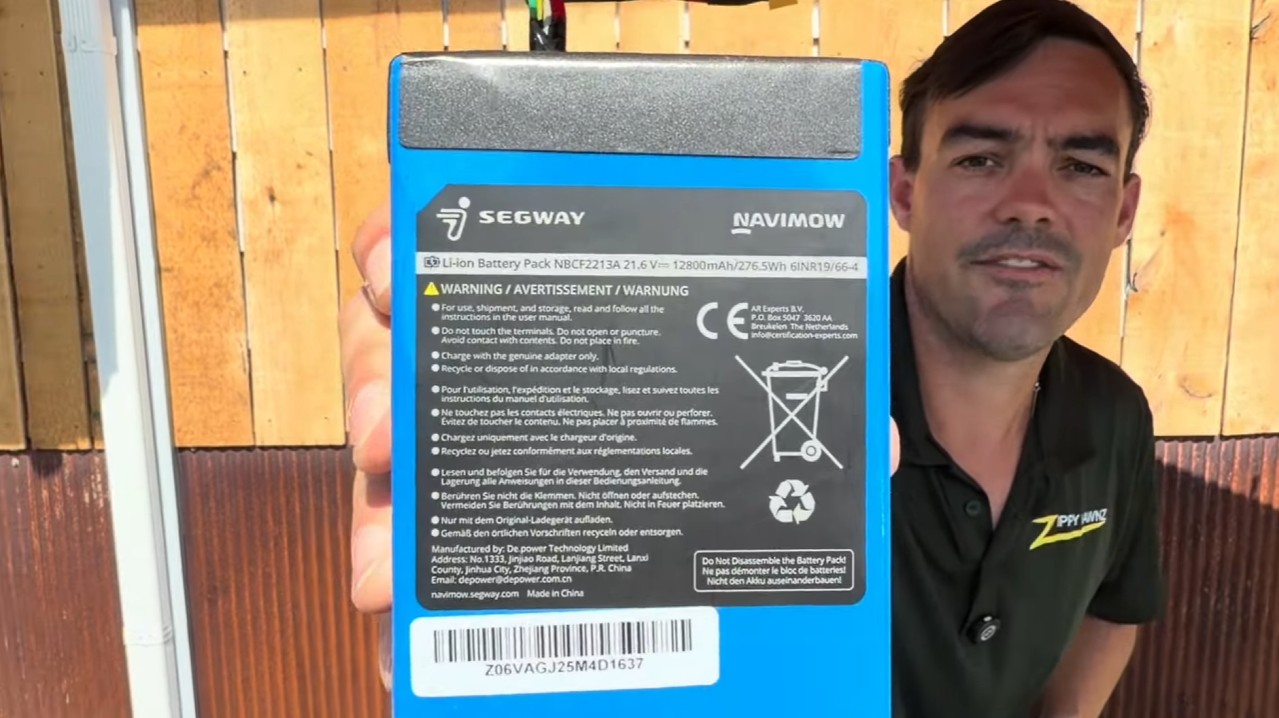
“How long will the battery last?” is the question that stops most people from buying a robot mower — and almost every answer online is a shrug. So we did the actual math, using real cycle-life data and the same battery model that powers our lawn checker.
The short version: a robot mower battery lasts anywhere from about 5 years to longer than the mower itself — and which end you land on is decided by your lawn, not the calendar.
First, the battery itself
The pack in the video is a Segway Navimow lithium-ion battery: 12.8Ah, 276.5Wh, 21.6V. It’s a swappable module — not glued into the chassis — which matters, because it means the mower isn’t disposable when the battery eventually ages.
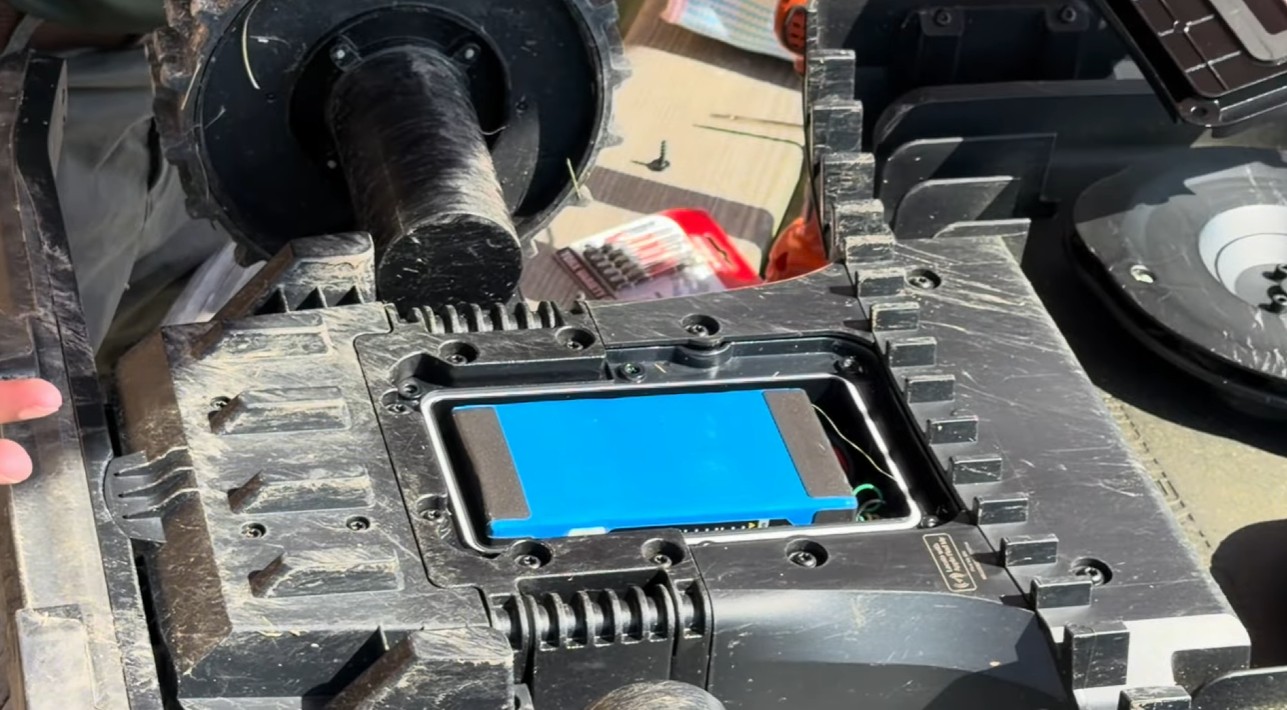
How lithium batteries actually age
A lithium pack isn’t rated in years — it’s rated in charge cycles. It holds near-full capacity for a long plateau, then gradually fades. The industry marker for “time to think about a replacement” is when it drops to 80% of original capacity — the mower still works, it just covers a bit less per charge.
Navimow rates this pack to stay near full for about 1,500 charge cycles before that fade begins. And here’s the key: one recharge ≈ one cycle. So the real question isn’t “how many years” — it’s “how many times a season does your mower recharge?” That’s pure lawn math.
The calculation, by lawn size
Number of recharges a season = lawn size × how often it mows × how long your season is. A small lawn sips a fraction of a charge each pass; a big lawn runs the pack down and back up several times a day.
Here’s what our battery model returns for the 12.8Ah Navimow pack, mowing ~3×/week over a 30-week season:
| Your lawn | Recharges per season | Near-full (no fade) | Until it dips under 80% |
|---|---|---|---|
| ¼ acre | ~85 | ~18 years | 30+ years (outlasts the mower) |
| ½ acre | ~165 | ~9 years | ~17 years |
| 1 acre | ~330 | ~4 years | ~8 years |
| 1½ acres | ~500 | ~3 years | ~5 years |
Read that top row again: on a quarter-acre yard, the battery effectively never wears out in a normal ownership window — you’ll replace the whole mower for other reasons first. On a big 1½-acre property it’s a different story: ~500 cycles a year burns through that 1,500-cycle plateau in about three years, and it drops under 80% around year five.
Same battery. Six times the workload changes “lasts forever” into “lasts five years.” That’s why a generic answer is useless — and why we built a calculator that runs your numbers.
⚠️ That's beyond this model's rated max — you'd want a bigger machine or a second unit.
Rough estimate at a maintenance cut. Get exact numbers for your address →
Each recharge in that estimate is one battery cycle — drag your lawn size up and watch the recharges climb. That’s the workload the table above turns into years.
Why robot mowers are gentle on batteries
There’s good news buried in how these machines work. Because a robot mower cuts a little and often, it does shallow, partial charges rather than deep 0-to-100% cycles — and shallow cycling is far kinder to lithium than the deep drains that age a phone or laptop. The dock trickle-tops it up between short runs, so the pack rarely sees the stressful extremes.
You can help it along: keep the dock out of relentless afternoon sun where you can (heat is the enemy of lithium), and over winter, store the mower around a half charge rather than dead-empty or brimming full.
When it does fade: the replacement cost
Eventually — years down the road — capacity drops enough that you’ll want a fresh pack. For this Navimow module that’s about $489. Spread across the 8–17 years it typically lasts on a normal lawn, that’s a few dollars a month, and it slots right back in. (For the full picture, see how much a robot mower costs to run — battery replacement included.)
See your battery’s actual lifespan
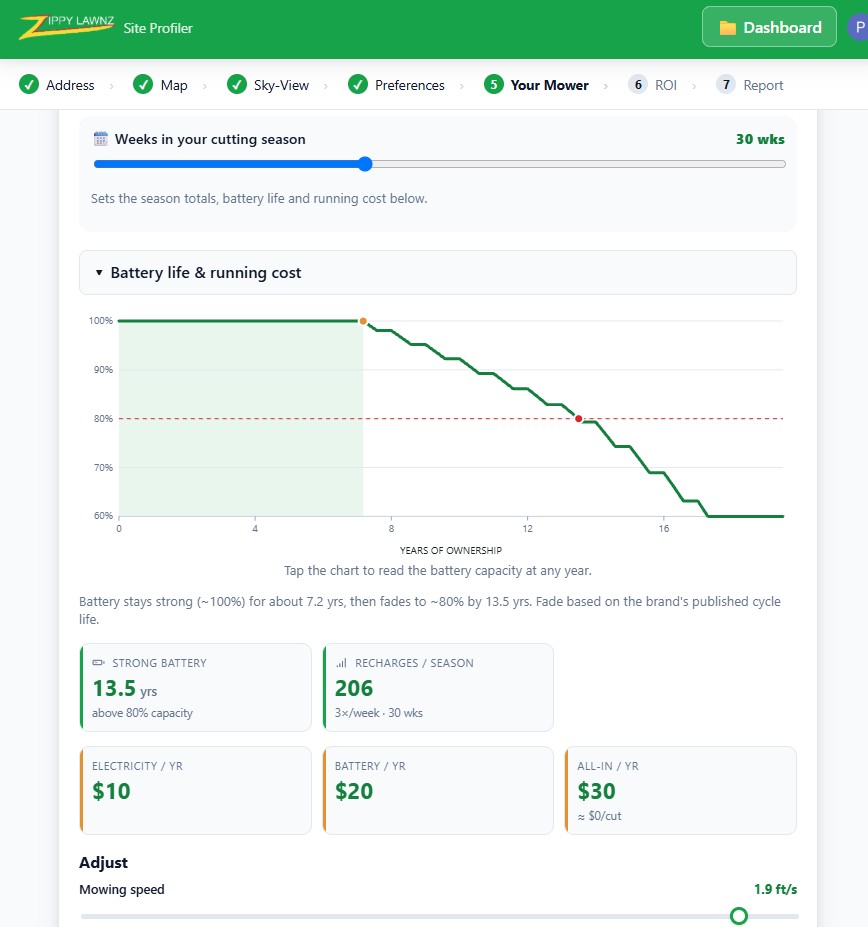
Averages are a starting point — your lawn size, mowing schedule and season length move the number a lot. Our free lawn check runs this exact model for your yard and the mower you’re considering, and shows the whole capacity curve: how many years it stays near-full, and when it crosses that 80% line.
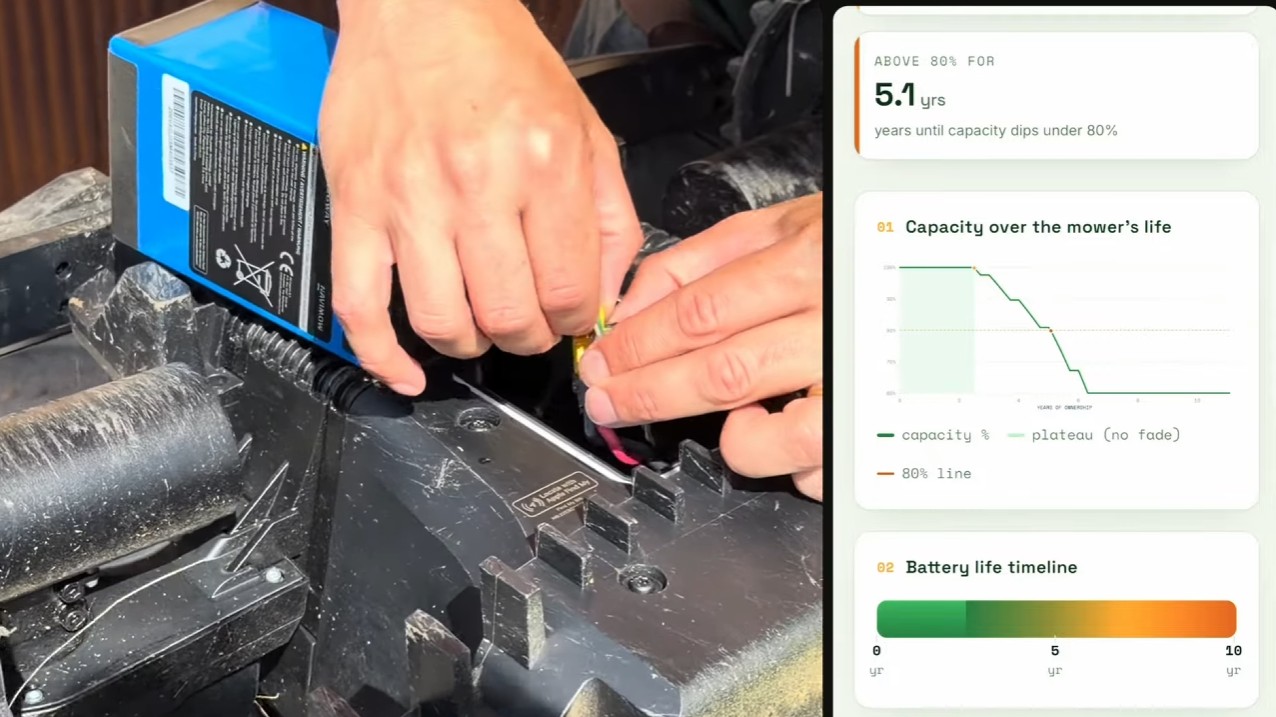
No spec-sheet guesswork, no account needed to start — just the real number before you spend a dollar.
Frequently asked
How many years does a robot mower battery last?
It depends far more on your lawn than on the calendar. On a small yard (about ¼ acre) the pack barely cycles and can stay near full capacity for 15+ years — it usually outlasts the mower. On a large yard (1½ acres) it cycles hard and holds above 80% capacity for roughly 5 years before you'd consider a replacement.
How many charge cycles does a lithium robot mower battery have?
Navimow rates its pack to hold near-full capacity for about 1,500 charge cycles, then fade gradually. One recharge is roughly one cycle. How fast you reach 1,500 depends on how many times a season the mower recharges, which is driven by your lawn size and mowing frequency.
Why does lawn size change battery life so much?
Each recharge is a cycle, and the battery only lasts so many cycles. A ¼-acre lawn might recharge the mower ~85 times a season; a 1½-acre lawn ~500 times. Same battery, but the big lawn burns through cycles roughly six times faster — so it fades in years instead of decades.
How much does a replacement robot mower battery cost?
For the 12.8Ah Navimow pack shown here, a replacement runs about $489. Spread over the 8–17 years it typically lasts on a normal lawn, that's only a few dollars a month — and on many models it's a user-swappable pack, not a glued-in unit.
How can I make my robot mower battery last longer?
Robot mowers are already gentle on their batteries because they cut a little and often — shallow, partial charges wear a lithium pack far less than deep 0-to-100% cycles. Beyond that: keep the dock out of direct afternoon sun where you can, and don't leave the mower stored at a full or empty charge for months over winter.
Keep reading
 Buying GuidesHow Much Does a Robot Mower Cost to Run?Robot mowers sip electricity — most cost a few dollars a month to run. Here's the real math on kWh, your rate, battery life and total cost of ownership.
 Installation & SetupWhat a Professional Robotic Mower Installation Actually Looks LikeWe filmed a robotic mower install start to finish — RTK placement, wall-mounted power, mapping, and training — and why the install matters more than the mower.
 Tips & MaintenanceNavimow Scheduling Explained: End Times, Cycles & ZonesHow Navimow mowing schedules really work — the end-time trap, the Mowing Cycle toggle, the 90% battery rule, and how to build a zone-based weekly schedule.
Explore the system
The mowers and pages behind this topic — see them sized to your yard.