
No More Mowing Hills: A Navimow X430 on a Carlisle, PA Septic Mound

Every lawn has a part nobody wants to mow. On this property, it rises on all four sides.
On this property in Carlisle, Pennsylvania, that part is a septic mound — and not a gentle one. The mound climbs from every direction, which means there’s no easy approach, no flat run-up, and no way to cheat it. Just a steep climb from whichever way you come at it.
If you’ve ever pushed a mower up a septic hill in July, you know the drill. You’re fighting the machine to keep it from sliding, walking sideways across the face, and burning through your Saturday morning.
Our customer had a better idea for how to spend that time. She’s a cyclist, and she was giving up two to three hours every single week to lawn mowing — hours she’d rather spend on the bike. So we put in a Segway Navimow X430.
Here’s the full installation, start to finish — the video above covers it in under six minutes.
Why hills are the real test for a robotic mower
Plenty of robotic mowers can handle a flat suburban lot. Slopes are where the differences show up fast. A robotic mower for steep hills has to deliver three things at once:
- Traction. The mower has to climb without spinning out or scalping the turf on the way up.
- Stability. It has to stay planted while turning across the face of the slope, not just going straight up it.
- Positioning accuracy. This is the one people miss. On a hill, the mower is constantly changing its angle relative to the sky — which is exactly when a weak satellite signal starts to drift.
That third point is why a septic mound is such a good stress test, and why the RTK setup matters as much as the mower itself. (It’s also why the steepest lawn we’ve ever mapped, in Annapolis, got the same X4 platform — traction and positioning are the whole game on steep ground, and this platform won our hills field test on both.)
A septic mound also has a specific requirement: you want it mowed, but you don’t want heavy equipment compacting it or tearing at the turf. A lightweight robotic mower taking a small amount off every day is genuinely better for the mound than a heavy walk-behind hitting it every ten days.

Step 1: RTK antenna on the roof eave
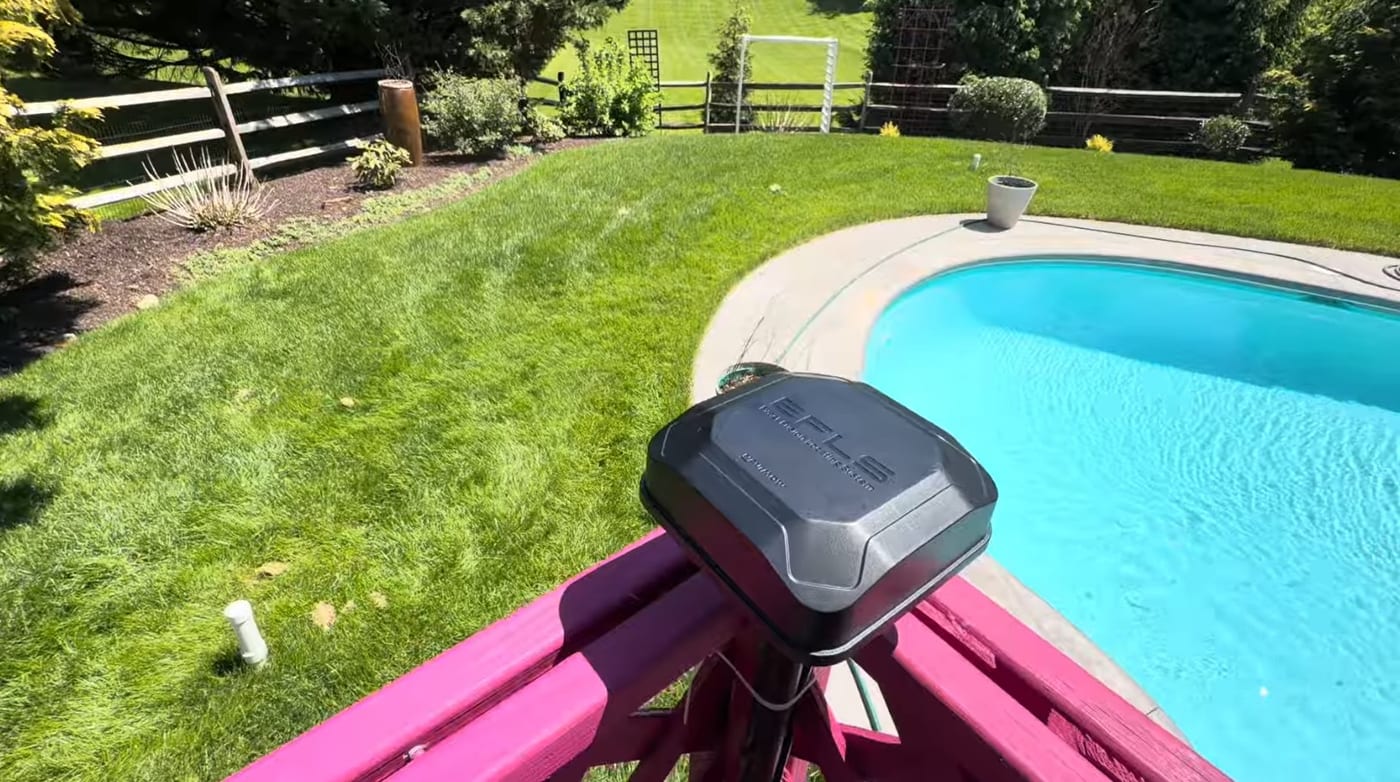
The RTK satellite receiver is the brain of the positioning system. It gives the mower a fixed reference point so it knows where it is down to centimeter accuracy — no boundary wire required.
RTK antennas need a clear view of the sky. The common shortcut is to stake it in the yard on the included pole, and that works — but it leaves a pole in the middle of the lawn, a cable running across the ground, and a target for string trimmers and curious kids.
We mounted this one on the roof eave instead. Roof mounting gets you three wins at once:
- A much better sky view. Higher up means fewer obstructions from trees, the house itself, and neighboring structures — which means a stronger, more stable fix.
- Nothing in the yard. No pole, no ground cable, nothing to mow around or trip over.
- It’s out of harm’s way. No weed-whacker damage, no getting bumped, no winter snow load sitting on it.
The wiring was run cleanly along the eave line and down to the power supply, tucked in and secured so it reads as part of the house rather than something bolted on afterward. If you’re weighing your own antenna spot, these are the four rules we follow on every install.
Step 2: Wall-mounted power supply and buried cables
This is the part that separates a professional install from a DIY one, and it’s mostly about what you don’t see when it’s finished.
The power supply was mounted on the wall, up off the ground. That keeps it out of standing water, away from splash-back and mulch, and out of the path of the mower itself. Cable management runs the leads in clean, straight lines with proper securing — no drooping loops, no zip-tie nests.
From there, we buried the cables running to the charging station. No cables snaking across the lawn, nothing for the mower to run over, nothing to catch a foot on, and nothing that looks like a construction site in the middle of the yard.
When it’s done right, a customer walks out and sees a charging dock and a lawn. That’s it. The infrastructure disappears.
That’s not just cosmetic, either. Buried and secured cables don’t get pulled loose, don’t get chewed by animals, don’t get nicked by a trimmer, and don’t fail in the middle of the season.
Step 3: Multi-zone mapping
With the hardware in and the RTK locked in, we mapped the property.
The Navimow app lets you define multiple mowing zones and set them up independently — different schedules, different cut heights, different mowing patterns. On a property like this one, that’s exactly what you want: the flat open lawn, the areas around plantings and the driveway, and the septic mound each get treated on their own terms. (Zoning decisions are where most mapping mistakes happen — and on sloped ground they matter enough that we wrote a whole playbook for hilly yards.)
We walked the customer through the app during the install, mapping each zone and setting the schedule together. That part matters. Handing someone a mower and a login isn’t an installation — knowing how to add a no-go zone, tweak a schedule, or adjust a cut height for a dry spell is what makes the thing actually get used.
Step 4: The hill
Then the moment of truth.
The X430 took the mound from multiple directions — up, across, and around — holding its line without slipping or bogging down. No spinning wheels, no scalped turf, no getting stuck at the crown. It just worked its way over the mound and carried on with the rest of the zone.
That’s the whole point. The single worst part of this lawn to mow is now the part that requires zero effort from anybody.
The result: two to three hours back, every week
Here’s what actually changed for this customer.
Before, mowing was a weekly obligation with a steep hill built into it. Now the Navimow X430 runs on a schedule and handles the whole property — mound included — while she’s out riding.
That’s 2–3 hours a week back. Over a mowing season in Pennsylvania, that adds up to somewhere in the neighborhood of 60 to 90 hours. More than two full work weeks, returned.
And the lawn actually looks better. A robotic mower cutting a small amount daily produces a denser, more uniform turf than a weekly cut ever will, and the fine clippings mulch straight back into the soil.
Video chapters
- 00:00 — Intro: The Steep Hill Problem
- 00:35 — RTK Antenna Roof Mount & Wiring
- 01:45 — Power Supply Wall Mount & Buried Cables
- 02:50 — Mapping Multiple Zones (App Walkthrough)
- 04:00 — The X430 Climbs the Hill
- 05:15 — Final Results & Wrap-Up
Thinking about your own hill?
Zippy Lawnz is an authorized dealer and service center for Segway Navimow, Mammotion, and Yarbo, with nationwide sales and remote support and hands-on installs across Pennsylvania, Maryland, Delaware, Virginia, and Colorado. We handle site evaluation, professional installation, RTK setup, zone mapping, and ongoing service.
If you’ve got a slope, a septic mound, or a tricky property and you’re wondering whether a robotic mower can handle it — we’ll walk the property with you and tell you straight.
- 📍 Check my lawn — free — your lawn’s real size, slope and satellite sky view, measured in about two minutes.
- 🗺️ Book a free site assessment — we’ll pull up your address, plan the antenna and dock, and quote the whole install.
- 🤝 Your local Carlisle / Cumberland County dealer page — sales, install and service for Carlisle, Mechanicsburg, Camp Hill and central Pennsylvania.
- 📞 Call or Text Us: 410-725-7500
Installed: Segway Navimow X430 (AWD) · Location: Carlisle, PA — Cumberland County, central Pennsylvania · Terrain: a septic mound, steep on all four sides · Setup: roof-eave RTK, wall-mounted power, buried dock cables, multi-zone mapping · Result: 2–3 hours a week returned
Frequently asked
Can a robotic mower really handle a septic mound?
Yes — and it's often the better tool for the job. Robotic mowers are light, they cut a little at a time, and they don't compact the mound the way a heavy walk-behind or rider does. A mound also rises on every side, so there's no easy approach for a person pushing a mower — while an AWD robot like the Segway Navimow X430 simply takes it from multiple directions as part of its schedule. The key is choosing a model rated for your slope and getting the RTK positioning dialed in, because a hill is exactly where a weak satellite fix starts to drift.
Do I need to bury the charging station cables?
You don't have to, but you'll be glad you did. Buried cables look better and hold up far longer than cables run across the surface: nothing for the mower to run over, nothing to catch a foot or a trimmer line, nothing for animals to chew, and nothing to pull loose mid-season. Pair it with a wall-mounted power supply up off the ground — out of standing water, splash-back and mulch — and the infrastructure effectively disappears: you walk out and see a charging dock and a lawn.
Does the RTK antenna have to go on the roof?
No. The included ground pole works fine on many properties. We recommend a roof eave mount when the yard has tree cover or obstructions, or when the customer would rather not have a pole and cable in the lawn. Roof mounting buys a much better sky view (a stronger, more stable fix), puts nothing in the yard to mow around, and keeps the antenna out of harm's way — no weed-whacker damage, no getting bumped, no snow load sitting on it.
How long does a professional robot mower installation take?
Most residential installs are a single visit. Mounting the RTK antenna, running and burying cables, setting the dock, mapping the zones, and training the homeowner on the app is typically about a half day. The training part matters as much as the hardware: knowing how to add a no-go zone, tweak a schedule, or adjust a cut height for a dry spell is what makes the mower actually get used.
Do you install robot mowers in Carlisle, PA?
Yes — Carlisle, Mechanicsburg, Camp Hill, Boiling Springs, all of Cumberland County and central Pennsylvania. Zippy Lawnz is an authorized dealer and service center for Segway Navimow, Mammotion and Yarbo, with nationwide sales and remote support and hands-on installs across Pennsylvania, Maryland, Delaware, Virginia and Colorado. We handle the whole job: site evaluation, professional installation, RTK setup, zone mapping and ongoing service. Call or Text Us: 410-725-7500.
Keep reading
 How-toRobot Mower Tips for Hilly Yards: 12 Ways to Win on SlopesTwelve field-tested robot mower tips for hilly yards: cutting height, wet-grass scheduling, exclusion zones, dock placement and slope-proof mapping from a dealer.
 Installation & SetupWhere to Install Your Robot Mower's RTK Antenna (4 Rules)Mount your robot mower's RTK antenna wrong and it drifts after a season. The 4 rules of RTK placement — open sky, height, rigid mounting, and reflective surfaces.
 Customer InstallsNavimow X430 vs. Maryland's Steepest Lawn: Annapolis InstallThe steepest lawn we've ever installed on: gas crews tore up this hilly Annapolis, MD property for years. How an AWD Navimow X430 made it 100% autonomous.
Explore the system
The mowers and pages behind this topic — see them sized to your yard.